
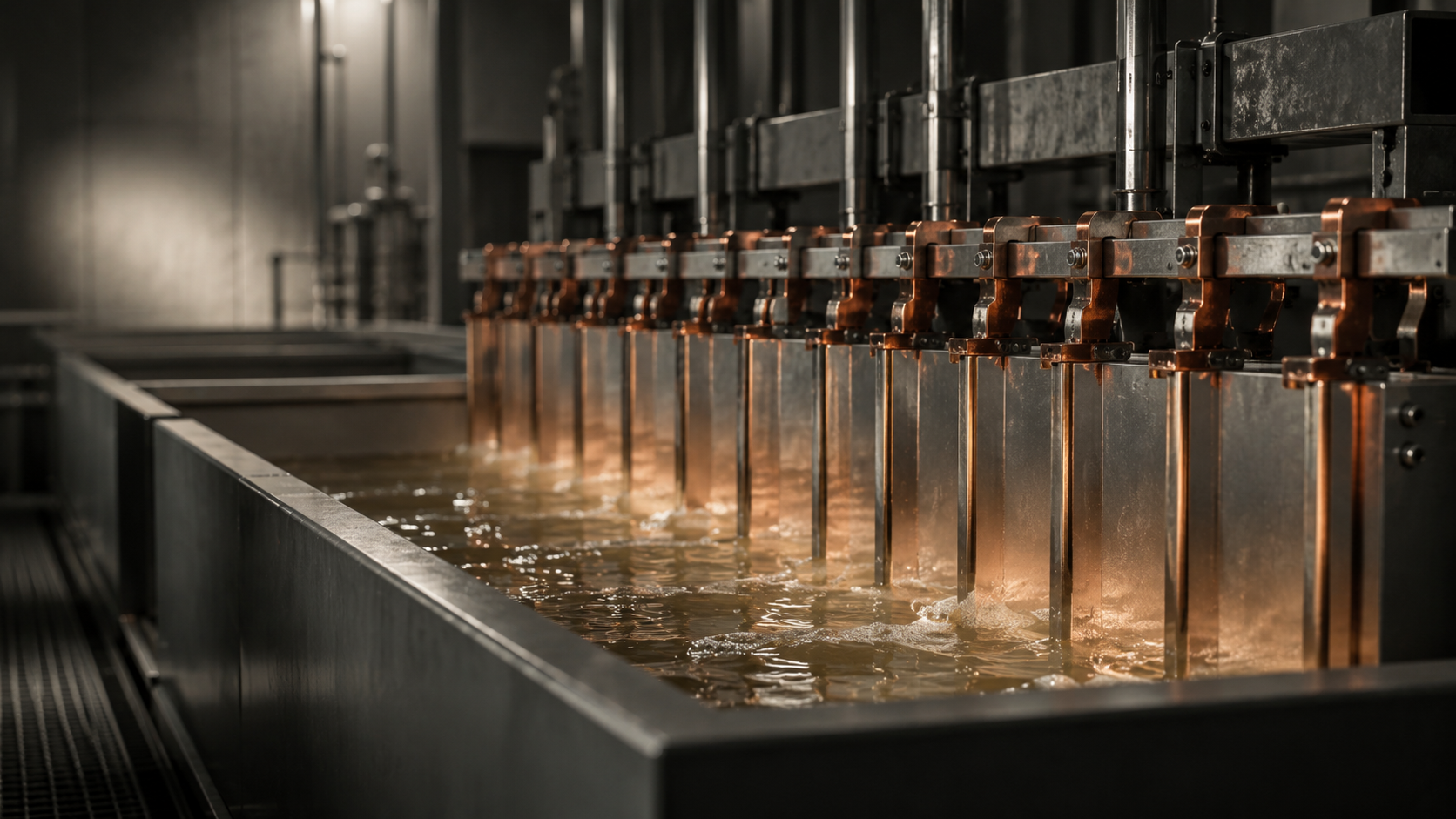
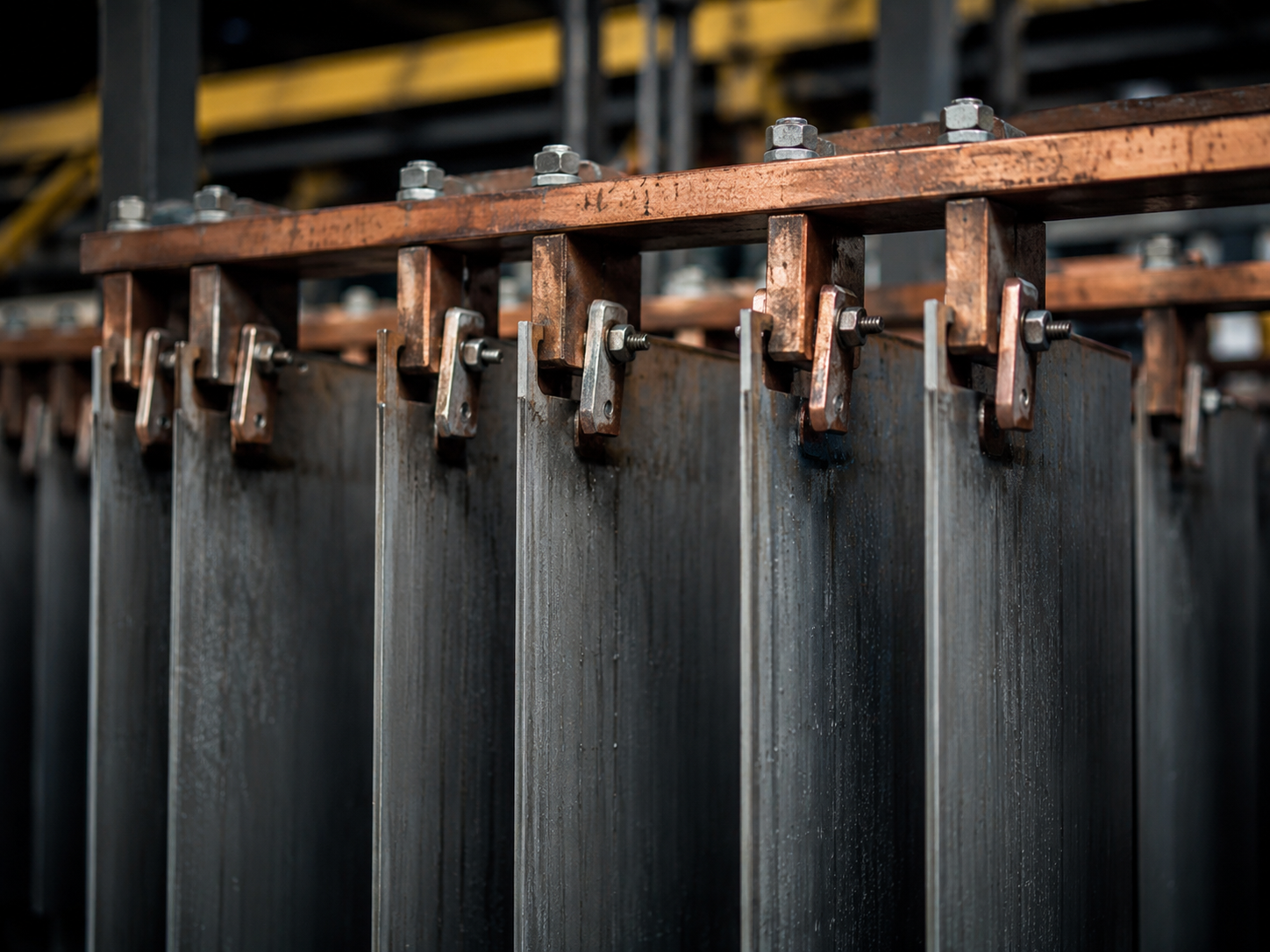
Same family. Different control philosophy.
Electrowinning is a conventional electrochemical technology for depositing metals from solution. Elmery’s EDRR is also electrochemical, but the difference is control: EDRR uses pulsed operation and redox replacement logic to improve selectivity in complex liquid streams where constant-current electrowinning can struggle with impurities, co-deposition or low concentrations.
Author:
Petteri Halli, CTO
Date:
Category:
EDRR vs
Electrowinning
Electrowinning (EW) is one of the best-known electrochemical recovery methods in hydrometallurgy. It applies electrical current to reduce dissolved metal ions onto a cathode. In the right solution, at the right concentration and purity, it can produce high-quality metal at industrial scale.
Elmery’s EDRR belongs to the same broad electrochemical family, and it could be roughly described as a more advanced and selective form of electrowinning. The difference is how the process is controlled. Instead of relying on a constant-current or conventional deposition approach, EDRR uses pulse-based electrochemistry to influence how and which target metals accumulate and how unwanted co-deposition is suppressed.
Where conventional electrowinning is strongest
Electrowinning shines when the electrolyte is prepared for it. It is widely used for metals such as copper and zinc, and it can be highly effective in mature operations with stable concentration, good conductivity and controlled impurity levels.
In other words, EW often performs best after the flowsheet has already done a lot of work: leaching, purification, concentration and impurity management.
Where EW can struggle
- Low metal concentrations can hurt current efficiency and economics.
- Impurities can affect deposit quality, current efficiency and cell performance.
- Mixed-metal streams can lead to co-deposition instead of selective recovery.
- Feed preparation can become expensive if the solution must be made EW-friendly first.
- Constant operating conditions can be less forgiving when real plant feeds drift.
What EDRR adds
EDRR adds another dimension of control. By adjusting waveform, duty cycle, frequency, amplitude and polarity, Elmery can tune the process toward the target metal or group of metals in a defined operating window. The aim is not just deposition. The aim is selective, predictable recovery in the kinds of liquid streams operators actually have.
That matters in precious metal refineries, base-metal bleed streams, recycling solutions and impurity-rich circuits where the target metal may be valuable but present in a difficult matrix.
| Question | Electrowinning | Elmery EDRR |
|---|---|---|
| Best fit | Bulk recovery from prepared electrolytes. | Selective recovery or impurity removal from complex dissolved streams. |
| Power mode | Usually constant-current or conventional DC operation. | Controlled pulsed electrochemical operation. |
| Feed demand | Often needs strong front-end purification and concentration. | Designed for real process streams within a defined electrochemical window. |
| Selectivity | Can be limited by co-deposition and impurity effects. | Pulse tuning aims to favour target metals and suppress unwanted reactions. |
| Retrofit logic | Usually a main production step. | Can be an add-on step, and in selected cases can integrate with existing EW infrastructure through a new power source and method. |
Where EDRR can sit in an EW plant
EDRR does not need to be framed only as a replacement. In many operations, the smarter route is integration. EDRR can be evaluated on a side stream, bleed stream or impurity-control loop before the main EW circuit pays the price. It can also be tested where valuable metals escape the main route because the stream is too dilute, too complex or too variable for conventional recovery.
For existing electrowinning environments, this is a practical message: Elmery is not asking operators to rip out what already works. The goal is to make the difficult stream behave better, recover more value and reduce the number of chemical corrections downstream.
When conventional EW is still the right tool
If the stream is already a clean, concentrated electrolyte for a single bulk metal, conventional EW may be hard to beat. Large-scale copper, nickel and zinc circuits prove that point every day.
EDRR becomes more relevant when the target is selective recovery rather than simple bulk deposition, or when impurities and low concentrations make the conventional EW route inefficient.
The practical test
The first step is not a generic debate about EW versus EDRR. It is one stream, one target and one operating window. Elmery looks at composition, pH, temperature, interferents and the current treatment route, then tests whether pulsed recovery can improve the outcome.
Precision is what we deliver. Predictability is what we leave behind.
FAQ
- Is EDRR just electrowinning?
No. Though EDRR could be roughly described as an advanced and selective form of electrowinning. EDRR is a pulse-based electrochemical process that uses controlled operating parameters and redox replacement logic to improve selective recovery. - Can EDRR use existing electrowinning equipment?
Yes, Elmery can integrate with existing EW infrastructure by changing the power source and operating method. If you have a EW system installed, EDRR can reuse the same cathodes, anodes and cells. - When should an EW operator test EDRR?
When impurity build-up, co-deposition, dilute losses, bleed treatment or valuable side streams create a problem the main EW circuit was not designed to solve.

Let’s talk.
No chemicals. Faster recovery.
More metals from any concentration.
Engineered to make complex recovery simple.